


When a bad OB/GYN outcome happens, the real problem usually isn’t what people think

There’s a specific kind of case that doesn’t leave easily.
Not because the clinician doesn’t understand the medicine.But because the outcome creates a quiet, persistent question:
“Was that actually a reasonable decision…or did I miss something I shouldn’t have missed?”
In OB/GYN, that question carries a particular weight.
Because decisions are made in conditions that don’t behave like textbooks:
incomplete or shifting clinical data
time pressure that compresses judgment
emotional intensity that runs through every interaction
outcomes that can be irreversible in minutes
And after a difficult outcome, most systems unintentionally push clinicians into one of two patterns:
1. Move on quickly (document, debrief briefly, continue work)
2. Rehearse endlessly (replay the case, search for the “miss”)
Neither actually improves future decision-making.
One avoids discomfort.The other risks turning uncertainty into self-doubt.
The gap no one trains for
Clinical training focuses on correctness at the point of care.
It does not consistently teach how to refine the decision process after uncertainty or adverse outcomes.
So when something goes wrong, clinicians often default to one of two adaptations:
Become more conservative and defensive
Or become more self-doubting and hesitant
Both reduce risk exposure.
Both also distort future judgment.
The real issue isn’t the outcome
Every clinical decision contains an internal prediction:
“Given what I see, this is what I expect will happen.”
After a difficult case, attention usually goes to the result.
But the real leverage is earlier:
How accurate was the internal signal you were working from—and how did you interpret it under pressure?
Without examining that structure, learning doesn’t really happen.
Only repetition does.
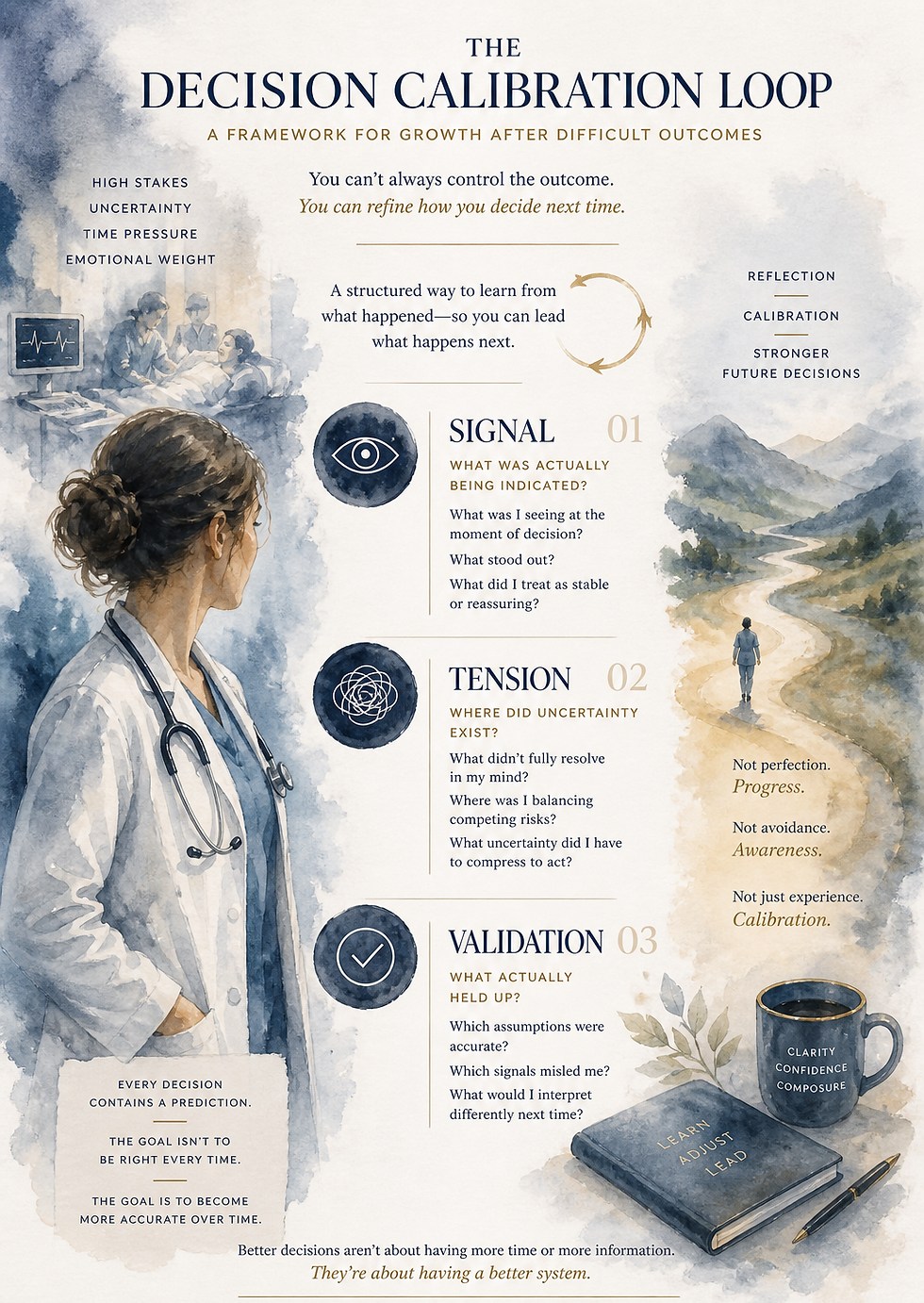
The Decision Calibration Loop (DCL)
The Decision Calibration Loop is a structured way to review and refine high-stakes clinical decisions without spiraling into overanalysis or emotional replay.
It is built on three phases:
Signal → Tension → Validation
1. Signal — What was actually being indicated?
Every decision begins with a signal.
Not just labs, imaging, or vitals—but the full set of cues that informed judgment at the time.
In hindsight, it’s easy to overwrite this.
This phase asks:
What was I seeing at the moment of decision?
What clinical signals stood out as most important?
What was I treating as stable or reassuring?
The goal is not perfection.
It’s accuracy about what the decision was actually based on—not what it looks like in retrospect.
2. Tension — Where did uncertainty exist?
This is the part most clinicians already feel—but don’t always formalize.
Tension is the space between:
competing risks
incomplete information
time pressure
and clinical intuition
This phase asks:
What didn’t fully resolve in my mind at the time?
Where was I balancing competing risks?
What uncertainty did I have to compress to act?
This is often where critical judgment lives—but it’s rarely documented or revisited.
Without naming it, it gets lost.
3. Validation — What actually held up?
This is where calibration happens.
Not judgment. Not blame.
Validation asks:
Which assumptions proved accurate?
Which signals were misleading or overweighted?
What would I interpret differently next time?
Importantly, this does not assume error equals failure.
It distinguishes:
unavoidable outcomes
from preventable miscalibration
Those are not the same thing.
Treating them as the same is where long-term decision drift begins.
Why this matters in OB/GYN specifically
In obstetrics, outcomes are high-stakes, time-sensitive, and emotionally charged.
That creates a predictable pressure pattern over time:
narrowing of clinical thresholds
increased defensive decision-making
reduced trust in internal judgment
Not because clinicians are less capable.
But because the feedback loop between decision and learning is often incomplete.
What changes when DCL is used consistently
Over time, this structure does something subtle but important:
Signals become easier to interpret under pressure
Tension becomes more explicit rather than internalized
Validation becomes less emotional and more precise
The result is not perfection.
It is more stable decision-making under uncertainty.
The underlying shift
You are not trying to eliminate difficult outcomes.
That isn’t realistic in this field.
You are trying to ensure that each case—especially the difficult ones—improves the quality of future decisions.
That requires structure.
Not just experience.Not just reflection.Not just resilience.
But calibration.
If there’s a case you’re still carrying
That usually signals something unresolved in the decision structure—not just the outcome.
I work with physicians to break down high-stakes decisions using the Decision Calibration Loop and refine how similar cases are approached going forward.
If you want to apply this to a specific situation:


Comments